Build a Website Search Engines Can Crawl, Understand, and Trust
WebTechGenix provides Technical SEO services that uncover and resolve the issues limiting your website's organic performance. We improve crawlability, indexing, architecture, Core Web Vitals, rendering, structured data, redirects, and technical reliability to create a stronger foundation for sustainable search growth.
Detailed technical analysis • Prioritized recommendations • Implementation support
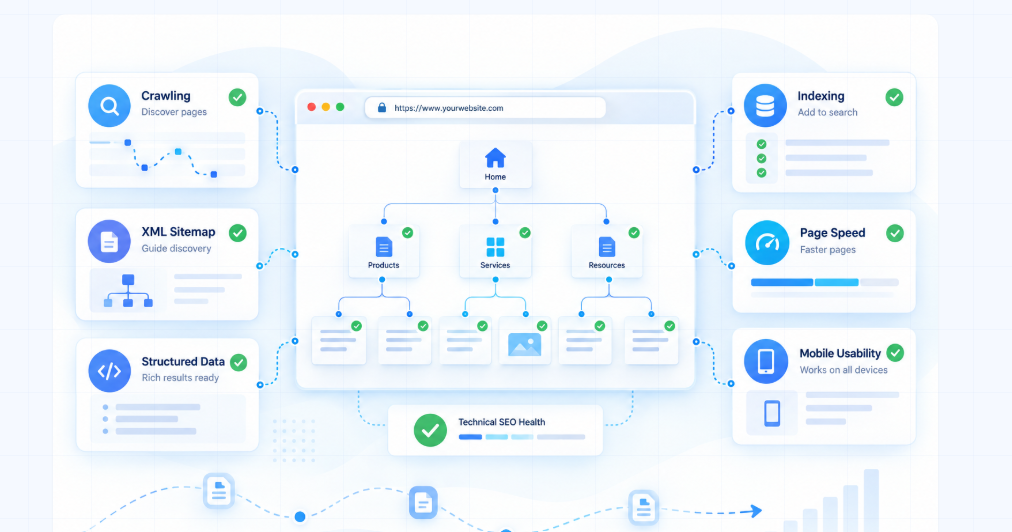
Remove the Technical Barriers Holding Your Website Back
Technical SEO is the process of improving how search engines access, crawl, render, understand, index, and serve a website. It focuses on the systems and configurations behind your pages rather than only the visible content.
A website may contain excellent content and still struggle in search if important pages are blocked, duplicated, difficult to discover, slow to load, incorrectly canonicalized, or dependent on JavaScript that search engines cannot process reliably.
Effective Technical SEO examines website architecture, internal links, crawl directives, XML sitemaps, canonical tags, redirects, status codes, mobile usability, Core Web Vitals, structured data, security, rendering, international targeting, and other technical signals.
At WebTechGenix, we translate complex technical issues into clear business priorities. We explain what is wrong, which pages are affected, why it matters, how the problem should be fixed, and how success will be verified after implementation.
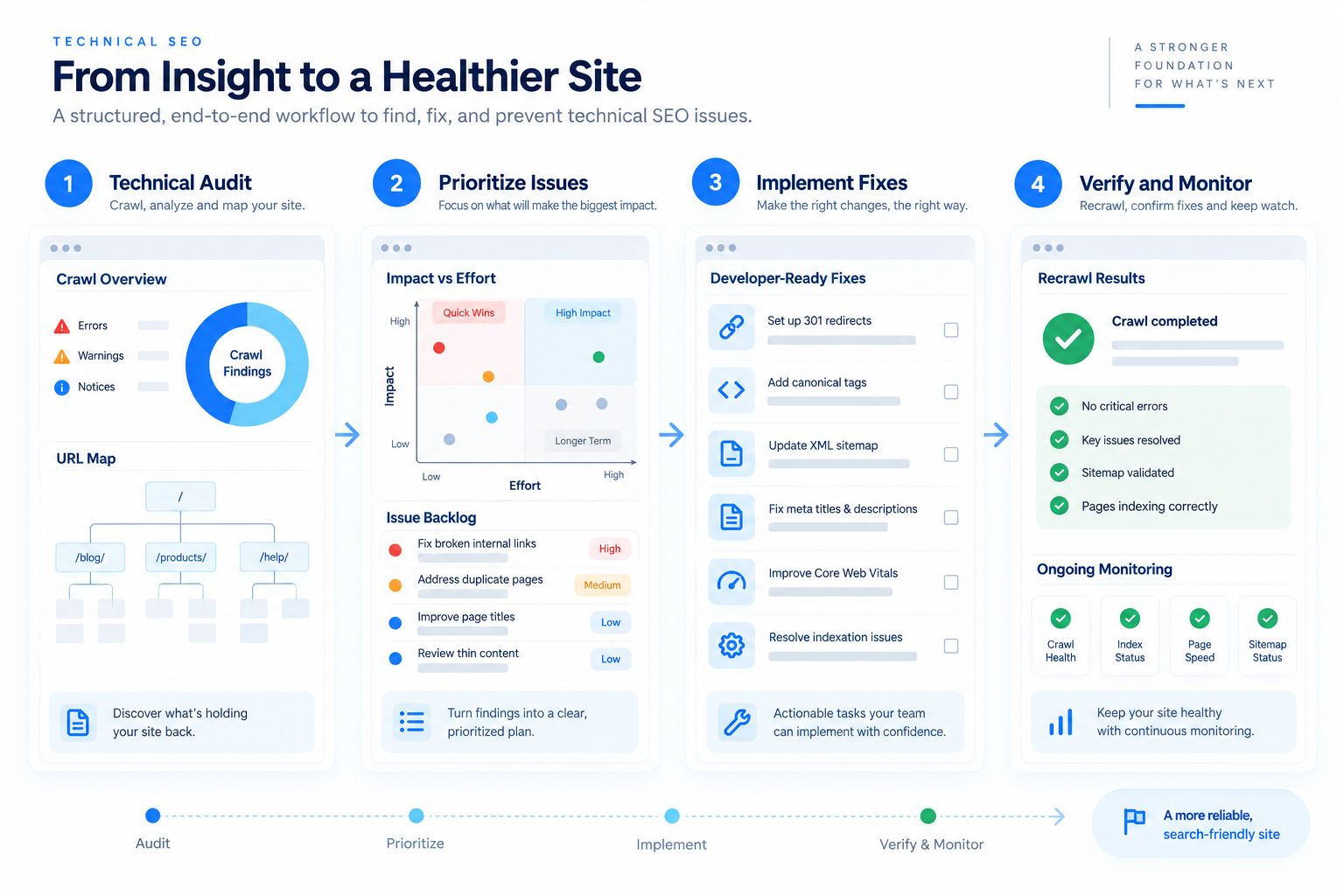
Turn a Stronger Technical Foundation Into Better Search Performance
Technical SEO helps search engines reach the right pages efficiently and gives visitors a faster, clearer, and more reliable website experience.
Improve Crawlability
Help search engines discover important content through clearer architecture, internal links, sitemaps, and crawl directives.
Strengthen Indexing
Reduce duplicate, blocked, low-value, and incorrectly canonicalized URLs so the correct pages can appear in search.
Improve Website Performance
Identify speed and Core Web Vitals issues that affect loading, responsiveness, visual stability, and user experience.
Protect Organic Visibility
Reduce the SEO risks associated with redesigns, platform changes, domain migrations, URL changes, and website launches.
Use Crawl Resources Efficiently
Help large websites guide search crawlers toward valuable pages instead of wasting resources on unnecessary URL variations.
Support Sustainable Growth
Create technical foundations that allow content, on-page SEO, link building, ecommerce, and international expansion to perform more effectively.
Everything Your Website Needs Behind the Pages
Every Technical SEO campaign is adapted to your platform, website size, business model, technical condition, and organic growth objectives.
Technical SEO Audit
We conduct a detailed review of crawling, indexing, architecture, status codes, redirects, canonicals, sitemaps, robots directives, performance, structured data, mobile usability, rendering, duplication, and internal linking. Findings are organized by impact, urgency, affected URLs, and implementation complexity.
Crawlability and Indexing Analysis
We identify important pages that search engines cannot discover, crawl, render, or index correctly. We also investigate unnecessary indexed pages, excluded URLs, crawl traps, orphan pages, and conflicts between directives.
Website Architecture Optimization
We review how categories, services, products, articles, filters, and supporting pages are organized. A clearer architecture helps visitors and search engines understand page relationships and reach important content with fewer unnecessary steps.
Core Web Vitals and Performance
We evaluate Largest Contentful Paint, Interaction to Next Paint, Cumulative Layout Shift, server response, image delivery, scripts, fonts, caching, and other performance factors. Recommendations distinguish real-user data from laboratory testing where possible.
XML Sitemap and Robots Optimization
We review XML sitemaps, robots.txt rules, meta robots directives, and related configurations. We ensure that sitemaps focus on preferred indexable URLs and that crawl rules do not accidentally block important content or resources.
Canonicalization and Duplicate Content
We identify duplicate or near-duplicate URLs created by parameters, pagination, filters, protocols, domains, tracking codes, print pages, or platform behavior. We recommend appropriate canonical tags, redirects, internal links, and indexation controls.
Redirect and Status Code Management
We audit 3xx redirects, 4xx errors, 5xx errors, redirect chains, loops, soft 404s, and outdated URLs. We develop safe redirect mappings that preserve user journeys and reduce unnecessary crawling.
JavaScript SEO and Rendering
We investigate whether important content, links, metadata, and structured data are available during rendering. We identify client-side rendering issues, blocked resources, delayed content, hydration problems, and JavaScript-dependent navigation that may affect discovery or indexing.
Structured Data Validation
We review existing structured data for technical errors, unsupported properties, content mismatches, duplication, and eligibility issues. Recommendations use schema types that accurately represent visible page content without promising rich results.
Website Migration Support
We plan and monitor domain changes, redesigns, platform migrations, HTTPS moves, international restructures, and URL changes. Support may include URL mapping, redirect testing, pre-launch crawling, staging review, launch-day checks, and post-migration monitoring.
Ecommerce Technical SEO
We address product variants, filters, sorting, faceted navigation, pagination, out-of-stock products, category architecture, duplicate product URLs, internal search pages, structured data, and crawl-budget challenges affecting ecommerce websites.
Technical Monitoring and Reporting
We monitor indexing changes, crawling issues, performance, errors, structured data, migrations, and other important technical signals. Reports explain what changed, what was fixed, what remains open, and which issues require development support.
More Than a Basic Website Health Score
Automated tools can identify symptoms, but technical findings require interpretation. We investigate how each issue affects real pages, search visibility, users, and business priorities.
Built for Websites With Performance, Indexing, or Scalability Challenges
Technical SEO is especially valuable when a website is growing, changing platforms, losing visibility, or managing a large number of URLs.
Crawling and Indexing Are Different—and Both Must Work
Crawling is the process search engines use to discover and access URLs. Indexing is the process of analyzing eligible pages and potentially storing them for use in search results. A crawled page is not automatically indexed, and an indexed page is not guaranteed to rank.
Technical problems can disrupt either stage. Search engines may be unable to discover a page because it has no internal links. They may be blocked from crawling it through robots.txt. They may crawl it but exclude it because of a noindex directive, canonical conflict, redirect, duplication, error, or insufficient value.
We examine how URLs move from discovery to crawling, rendering, indexing, and search eligibility. We then prioritize fixes around the pages that matter to your business.
Following technical best practices can improve eligibility and understanding, but crawling, indexing, and rankings are never guaranteed.
Improve Performance Using Real Data and Clear Priorities
Website performance influences user experience, engagement, and conversion opportunities. Core Web Vitals provide specific measurements related to loading performance, interaction responsiveness, and visual stability.
We assess both field data, which reflects eligible real-user experiences, and laboratory data, which helps diagnose specific technical causes. These data sources may not always produce identical results because they measure different conditions.
Our recommendations may involve image sizing and formats, critical resources, JavaScript execution, CSS delivery, server response, caching, third-party scripts, font loading, content rendering, and layout stability.
Performance should not be treated as a one-time score-chasing exercise. We focus on meaningful improvements across representative templates and real user journeys.
Largest Contentful Paint
Measures how quickly the main visible content is displayed.
Interaction to Next Paint
Measures how quickly the page responds visually to user interactions.
Cumulative Layout Shift
Measures unexpected movement of visible page elements.
How Technical SEO Supports On-Page and Off-Page SEO
Technical SEO ensures that search engines can access and process the website correctly. On-page SEO improves the relevance, usefulness, and structure of individual pages. Off-page SEO builds external authority, recognition, and trust signals.
These disciplines are connected. Strong content cannot perform effectively if it is blocked from indexing. Relevant backlinks may lose value if they point to broken URLs or redirect chains. A technically healthy website still needs valuable content and meaningful authority to compete.
We evaluate the complete situation and explain whether a problem requires technical implementation, content improvement, authority development, or a combination of services. Learn more about our On-Page SEO Services and Off-Page SEO Services.
Technical SEO
- Crawling
- Indexing
- Performance
- Architecture
- Rendering
- Sitemaps
- Redirects
- Canonicals
- Migrations
On-Page SEO
- Search intent
- Content
- Keywords
- Metadata
- Headings
- Internal links
- Images
- Readability
- Conversions
Off-Page SEO
- Backlinks
- Digital PR
- Brand mentions
- Outreach
- Citations
- Authority
- Reputation
- Partnerships
- Referral visibility
Technical SEO Support Before, During, and After Migration
Website migrations can affect URLs, internal links, content, metadata, canonicals, structured data, performance, analytics, and search visibility. Without careful planning, valuable pages may become unavailable, redirect incorrectly, lose internal authority, or disappear from search.
We support domain moves, platform changes, redesigns, HTTP-to-HTTPS moves, international restructures, subdomain or subfolder changes, and large-scale URL updates.
Before Launch
Crawl the existing website, identify valuable URLs, review the staging environment, prepare redirect mappings, benchmark performance, and document important SEO elements.
During Launch
Test redirects, canonicals, robots directives, sitemaps, analytics, internal links, status codes, structured data, and critical page templates.
After Launch
Monitor crawling, indexing, rankings, errors, traffic, redirects, performance, and unexpected URL behavior. Prioritize urgent corrections using live data.
No migration is completely risk-free. Careful planning and monitoring help reduce avoidable problems and shorten recovery time.
A Clear Path From Diagnosis to Verification
Discovery and Technical Setup
We learn about your website, platform, development resources, recent changes, business priorities, analytics, Search Console access, and known technical concerns.
Crawling and Data Collection
We collect information from website crawls, search tools, analytics, server responses, page templates, performance tests, and other relevant sources.
Issue Analysis and Prioritization
We validate findings and prioritize them according to impact, affected pages, urgency, business value, risk, and implementation effort.
Implementation Support
We implement approved changes where access and scope allow, or provide clear technical requirements for your developers and platform teams.
Testing and Monitoring
We verify completed fixes, recrawl affected areas, monitor search data, document outcomes, and identify additional opportunities.
Technical Findings Your Team Can Actually Use
Every recommendation should make it clear what the issue is, why it matters, where it occurs, and how it should be resolved.
Prioritized Technical Audit
A structured report organized by impact, urgency, affected templates or URLs, recommended fix, and implementation responsibility.
Crawl and Indexation Analysis
A review of how search engines discover, access, render, canonicalize, and index important areas of the website.
Implementation Specifications
Developer-ready requirements with examples, expected behavior, affected pages, acceptance criteria, and testing instructions.
Redirect and URL Mapping
Redirect plans for migrations, deleted pages, URL changes, consolidation, and broken destinations where required.
Performance Recommendations
Template-level findings covering Core Web Vitals, images, scripts, fonts, server response, layout stability, and other performance opportunities.
Structured Data Review
Validation findings and implementation guidance based on relevant, visible, and accurate page content.
Fix Verification
Testing of completed changes to confirm that the issue has been resolved and has not created new crawl, indexation, or user-experience problems.
Monitoring and Reporting
Clear reporting covering completed work, unresolved issues, indexation changes, performance trends, and recommended next steps.
See What Focused Technical SEO Can Achieve
Technical SEO results should be supported by verified website and search data rather than generic health scores.
How We Resolved Technical Barriers for a [Client Industry] Website
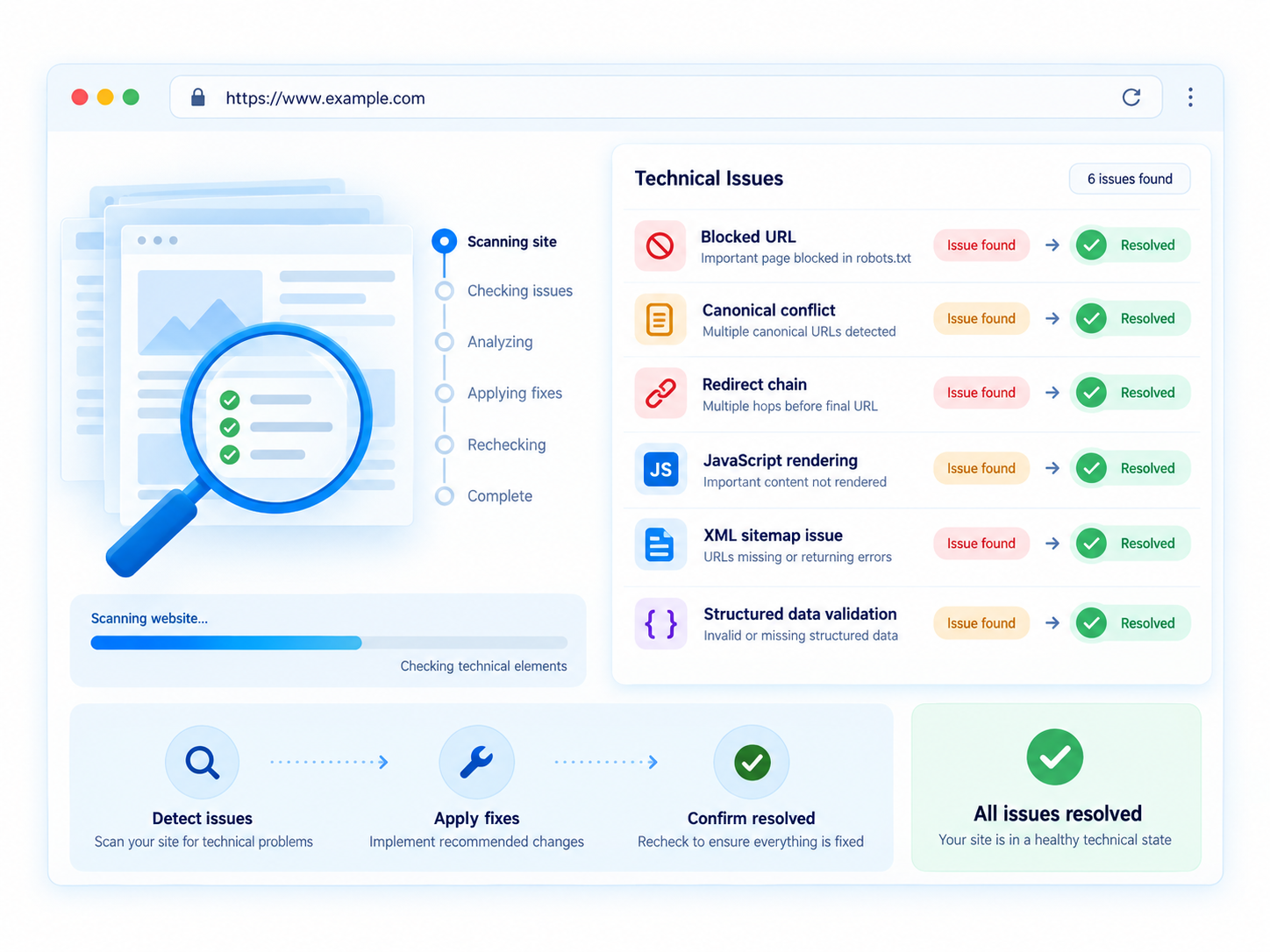
Challenge
The website contained valuable pages but had duplicate URLs, redirect chains, inconsistent canonicals, crawl traps, sitemap errors, and important content located too deeply within the site architecture.
Work Completed
We audited crawling and indexing, consolidated duplicate signals, corrected internal links, improved sitemap quality, simplified crawl paths, resolved redirect chains, and provided implementation requirements for the development team.
Verified Results
- [Verified reduction in crawl errors]
- [Verified improvement in valid indexed pages]
- [Verified Core Web Vitals improvement]
- [Verified improvement in organic clicks]
- [Verified recovery following migration or technical fixes]
Replace these placeholders only with results supported by Search Console, analytics, crawl comparisons, performance reports, server logs, or another reliable source. Do not publish invented data.
Technical SEO Expertise Across Different Platforms and Markets
Technical challenges vary according to website size, platform, rendering method, content model, and business requirements.
A small service website may need help with indexation, internal linking, and performance, while a large ecommerce platform may require ongoing management of product variants, filters, parameters, pagination, and crawl resources. We adapt the audit and implementation plan to the website's real level of technical complexity.
A Technical SEO Partner Focused on Clear, Actionable Solutions
Evidence-Based Audits
We validate automated findings instead of reporting every tool warning as a critical SEO problem.
Business-Focused Priorities
Recommendations are prioritized around affected pages, organic opportunity, business value, risk, and implementation effort.
Developer-Ready Guidance
Technical requirements include clear examples, expected behavior, and testing criteria for implementation teams.
Implementation Support
We can collaborate with developers, designers, content teams, hosting providers, and internal stakeholders.
Clear Communication
Complex technical issues are explained in practical language so decision-makers understand the impact and required action.
Fix Verification
We test completed changes rather than assuming that implementation automatically resolved the original issue.
Transparent Reporting
You receive a clear record of findings, completed fixes, open tasks, responsibilities, and next steps.
No Ranking Guarantees
We improve technical eligibility and performance without promising crawling, indexing, traffic, or fixed ranking positions.
Technical SEO Packages Built Around Your Website
Technical SEO packages start at $499 per month. Final pricing depends on your website size, platform, number of templates, technical complexity, development requirements, migration status, and monitoring needs.
Included with Your Campaign
- Initial Technical SEO audit
- Crawlability and indexation analysis
- Website architecture review
- XML sitemap and robots review
- Canonical and redirect analysis
- Core Web Vitals assessment
- Structured data validation
- Prioritized implementation roadmap
- Fix verification
- Performance monitoring and reporting
Not sure which plan you need? Request a free audit and we will recommend the most appropriate starting point.
Request a Free Technical SEO Audit
Tell us about your website and any performance or indexing concerns. We'll review crawling, indexing, architecture, Core Web Vitals, and rendering to identify what may be limiting your search performance.
- No-obligation initial review
- Prioritized, developer-ready recommendations
- No vague health scores
- Clear implementation support
Questions Business Owners Ask About Technical SEO
Clear answers about audits, indexing, performance, migrations, implementation, and what your business can realistically expect.
Ready to Fix What Is Holding Your Website Back?
Request a free, no-obligation Technical SEO audit and discover the crawling, indexing, performance, architecture, and rendering issues affecting your website.
No vague health scores • No hidden issues • Clear implementation priorities

